
Before You Start—Know How You’ll Finish

SUCCESS STARTS WITH THE ATTITUDE, NOT THE MARKET
January 22, 2026
Beyond the Huddle: Why Every Business Needs a Game Day Plan
February 11, 2026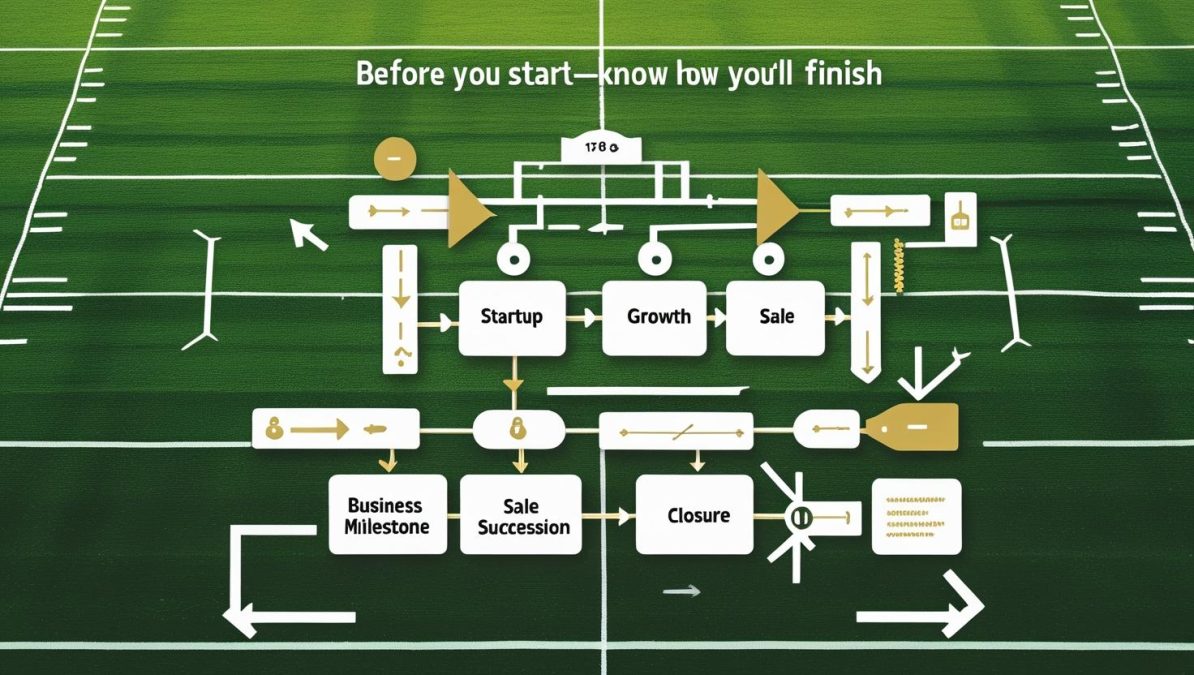
When a football team hits the field, there’s no mystery about what they want: to win the game. Every down, every play, and every decision is made with one goal, scoring more points than the opponent. In business, that same level of clarity is often missing. Many entrepreneurs get caught up in day-to-day tasks and forget the ultimate reason they started in the first place.
In football and in business, the end is not just a destination; it’s the strategy.
Think Like a Champion: Define the Final Score:
Imagine a coach designing a play without knowing what down it is or how many yards they need. That would be absurd. Yet this is precisely what many entrepreneurs do when they launch a business without a clearly defined goal or endgame.
Are you building to sell?
Do you want to pass your business to the next generation?
Is your goal to retire with passive income?
If you haven’t asked these questions, you’re not running your business—you’re reacting to it.
Exit Strategy Is Not Optional:
Every player knows they’ll leave the game eventually. The exit is inevitable, whether it’s retirement, injury, or a championship-ending moment. Business is no different. The smart move is to plan the exit from day one.
There are typically three types of exits:
Succession – Transitioning to a family member or internal leader.
Sale – Selling to a third party, often a competitor or private equity group.
Closure – Shutting down after maximizing profits.
Investors won’t fund a startup without a clear exit strategy, nor should you build a business without one. Remember, you are the investor in your business. Even for local businesses, the question isn’t if you’ll exit. It’s how and whether you’ll do it profitably.
The Real MVP: Profitability
Flashy stats do not matter in football if you do not win the game. Business works the same way. Revenue, employee count, and social media followers are great—but profit is the score that matters.
Profits fund retirement.
Profits increase valuation.
Profits make transitions smoother.
No matter your exit route, a profitable business is easier to hand off, sell, or wind down on your terms.
From Daily Huddles to Long-Term Wins”:
A common trap entrepreneurs fall into is “firefighting” mode—always reacting, never planning. It’s the equivalent of a team that only plays defense. Winning teams have playbooks. They practice offense. They call timeouts strategically.
Ask yourself:
How does today’s decision affect your 5-year goal?
Are your team’s activities aligned with your vision?
Can you clearly explain how your business makes money and creates value?
Beyond Business: Redefining the Win:
While business success can be measured in profits, life success must be measured in joy and fulfillment. For some, that’s a beach house and early retirement. For others, it’s building a community organization, teaching, or simply having time to coach their kid’s soccer team.
Define what happiness looks like for you—personally and professionally—and make that your “championship game.”
Your Life, Your Legacy:
There is no one-size-fits-all exit. But every business owner should be thinking about two things:
How does this business serve my life?
What will be my legacy when I leave it?
Starting with the end doesn’t mean rushing to it. It means moving with intention, knowing that every quarter, every play, every decision gets you closer to a defined victory.
Final Thought
In the game of business and in life, every champion starts with a vision. They knew what winning looked like. They planned for it. And they pursued it—ethically, morally, and legally.
So here’s your challenge:
What does your scoreboard say—and what’s your plan to win?
This blog post draws on the insights from the second chapter of my book “First and Ten on the Twenty…is it Football, Business or Life?”, where twenty-four aspects of the business and game of football are explored in depth on how they can be applied to business and life. For more on strategic planning and achieving business excellence, delve into the full text and discover how to apply these principles.
Too many business owners focus on launching and growing, but few plan for how it all ends. Whether you’re building a startup or running a long-standing company, your real success depends on knowing your exit strategy.
In my latest blog, “Before You Start—Know How You Will Finish,” I explore how strategic planning—borrowed from the playbook of football—can position your business (and your life) for long-term success, profitability, and personal fulfillment.
⚡ If you want to win the game, you need to start with the final score in mind.