
PREPARATION DRIVEN BUSINESS BRIEF™ #7 -Why Do Small Issues Become Major Problems?

PREPARATION DRIVEN BUSINESS BRIEF™ #5 – Why Are We Constantly Behind Schedule?
October 6, 2026
PREPARATION DRIVEN BUSINESS BRIEF™ #8 – Why Does the Organization Seem Stuck in Survival Mode?
October 8, 2026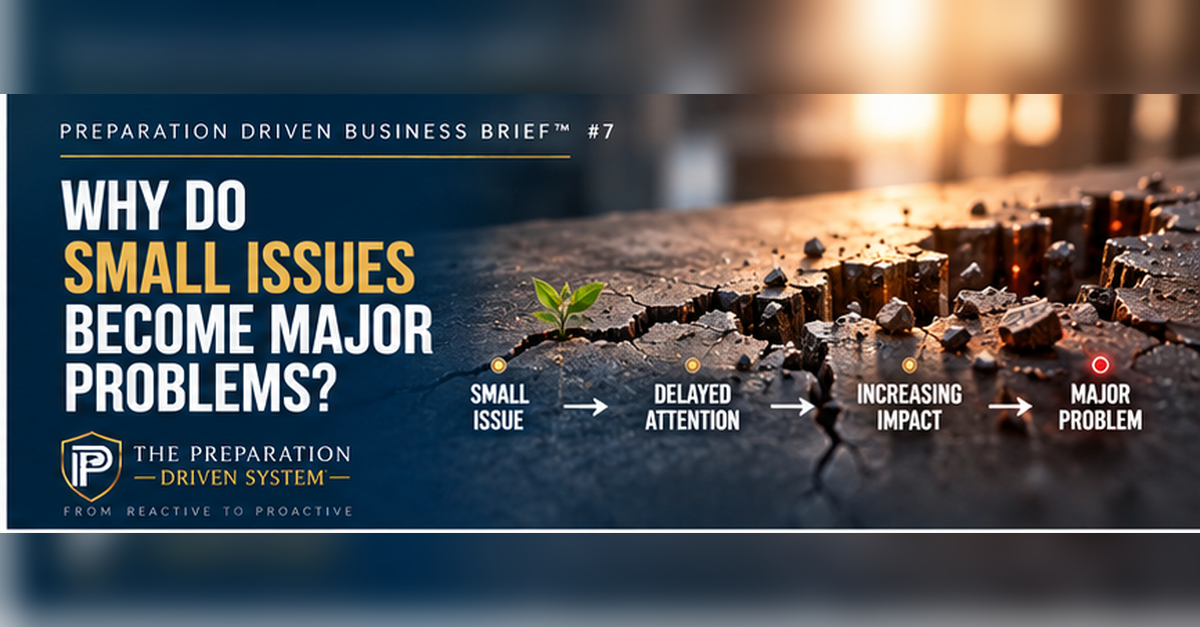
Why Do Small Issues Become Major Problems?
Observation
A customer raises a minor concern. A project begins slipping by a few days. An expense comes in slightly higher than expected. An employee’s performance changes. A piece of equipment begins behaving differently.
None seems serious enough to demand immediate attention.
So the organization waits.
The customer concern becomes dissatisfaction. The schedule problem affects another project. The expense becomes part of a larger cash-flow issue. The performance concern spreads to the team. The equipment fails when it is needed most.
Small problems rarely announce the moment when they become large ones.
They simply become progressively more expensive, more disruptive and more difficult to resolve while everyone waits for proof that the problem is serious.
Business Impact
The cost of delayed attention is rarely limited to the original problem.
A small operational issue can consume management time. A minor customer concern can jeopardize future business. A schedule variance can affect labor, billing and cash flow. An employee issue can influence an entire team’s performance.
And as problems grow, options frequently shrink.
The organization that could have chosen among several inexpensive responses early may later face only a few costly ones.
This is where delay becomes particularly dangerous. Waiting can feel prudent because leadership is avoiding an overreaction.
But there is a difference between not overreacting and not preparing.
Doing nothing is still a decision—and sometimes an increasingly expensive one.
How The Preparation Driven System™ Addresses It
The Preparation Driven System™, created by Todd Smith, does not suggest that every small issue deserves a major response.
It teaches leaders to determine which small issues deserve attention before they deserve alarm.
Preparation-driven organizations establish points at which observation becomes investigation and investigation becomes action.
That might mean identifying acceptable project variances, monitoring changes in customer behavior, reviewing financial trends before liquidity becomes urgent, or addressing changes in employee performance before they become established patterns.
The important question isn’t simply, “How serious is this today?”
It is also:
“If nothing changes, what could this become?”
That question moves leadership away from waiting for severity and toward evaluating consequence.
The objective is not to eliminate every problem while it is small.
It is to recognize which small problems have the potential to become large enough that leadership will later wish it had acted sooner.
Preparation Principle #7
The least expensive moment to address a major problem is often when it still looks too small to matter.
The Question
Think about one significant problem your organization dealt with during the past year. When did it become expensive—and how much earlier was there an opportunity to address it while your options were greater?
Todd Smith
Creator, The Preparation Driven System™