
PREPARATION DRIVEN BUSINESS BRIEF™ #4 -Why Are We Always Reacting Instead of Planning?

PREPARATION DRIVEN BUSINESS BRIEF™ #3 -Why Does Every Crisis Feel Unexpected?
September 29, 2026
PREPARATION DRIVEN BUSINESS BRIEF™ #5 – Why Are We Constantly Behind Schedule?
October 6, 2026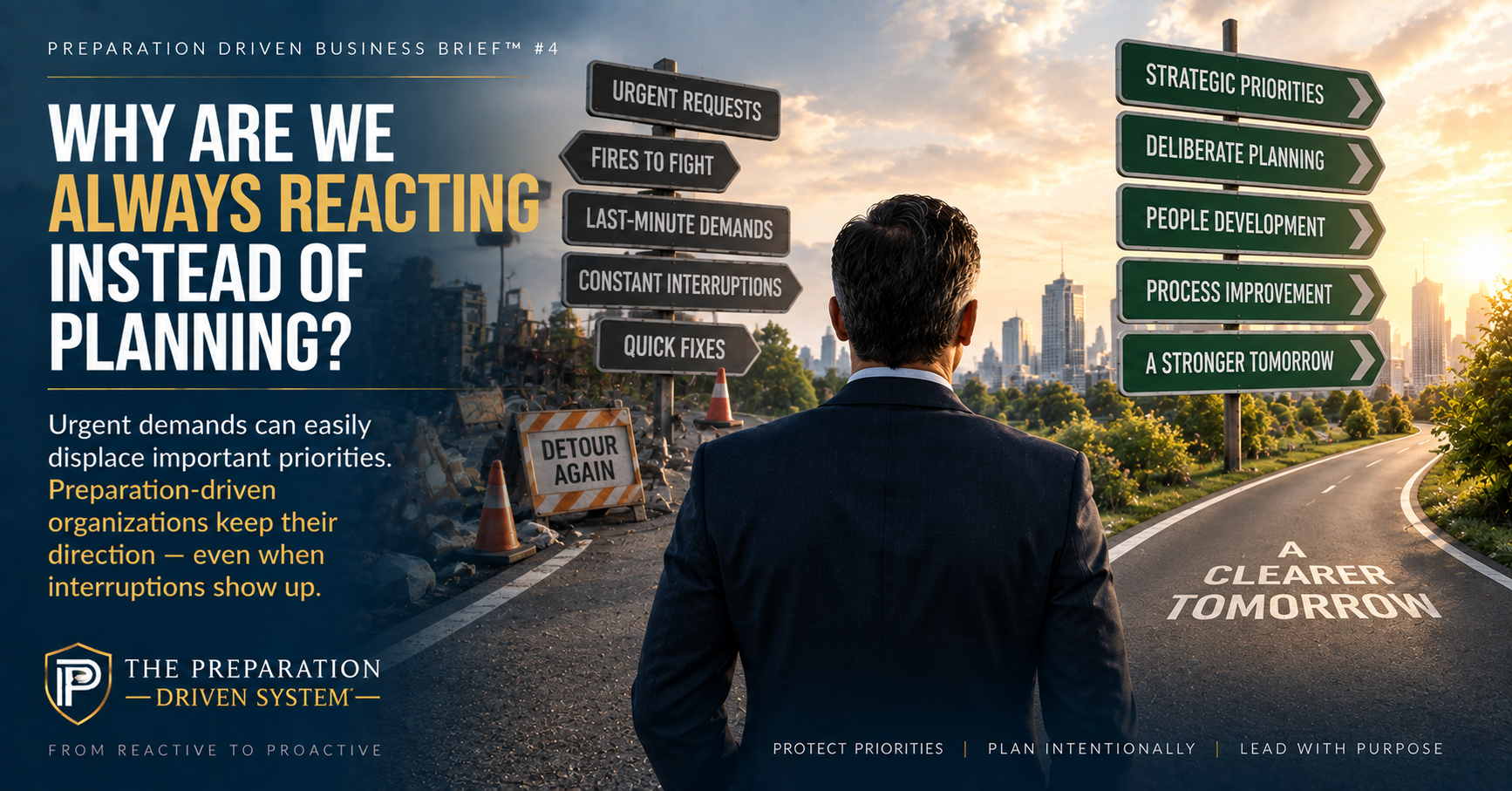
Why Are We Always Reacting Instead of Planning?
Observation
Most organizations don’t lack plans.
They lack protected attention for them.
The strategic priorities discussed at Monday’s leadership meeting compete with Tuesday’s customer issue, Wednesday’s staffing problem and Thursday’s unexpected operational demand. Each interruption may be legitimate. Each may require attention.
But something happens when urgent matters consistently determine where leadership spends its time.
The organization continues planning, but planning becomes an activity rather than the basis for decisions. Priorities remain on documents while immediate demands determine what actually gets done.
Reactive organizations rarely decide to abandon their plans.
Their plans are gradually displaced by whatever feels most urgent today.
Business Impact
When urgency repeatedly overrides planning, organizations can work extraordinarily hard without moving consistently toward their intended outcomes.
Projects begin and stall. Strategic initiatives remain unfinished. Managers receive competing priorities. Resources move toward the latest demand. Employees become reluctant to invest fully in long-term initiatives because experience tells them another priority may soon replace them.
The organization also loses an important leadership capability: the ability to distinguish what requires attention now from what deserves preparation before it becomes urgent.
Over time, planning loses credibility.
Employees may still participate in planning meetings, but behavior communicates a different message:
The plan matters—until something else happens.
How The Preparation Driven System™ Addresses It
The Preparation Driven System™, created by Todd Smith, treats planning as more than deciding what an organization wants to accomplish. Preparation connects today’s actions and decisions to tomorrow’s intended outcomes.
That distinction matters.
A plan can describe a destination and still fail to influence what happens Monday morning.
Preparation-driven leaders continually translate objectives into present-day decisions: What must happen next? What could interfere? What information will be required? Which decisions should be made before they become urgent? What resources need to be available? What should not be allowed to displace the priority?
This doesn’t mean ignoring immediate problems. Leaders still respond when circumstances require it.
The difference is that reaction no longer automatically controls direction.
Prepared organizations create enough clarity around priorities that leaders can handle today’s demands without continually sacrificing tomorrow’s objectives.
Planning identifies where you intend to go.
Preparation determines whether today’s actions are actually taking you there.
Preparation Principle #4
A plan that does not influence today’s decisions is only a description of tomorrow’s intentions.
The Question
Review your organization’s most important priorities. If someone observed only where leadership spent its time during the past thirty days, would they be able to identify what those priorities are?