
PREPARATION DRIVEN BUSINESS BRIEF™ #10 – Why Are Our Leaders Constantly Overwhelmed?
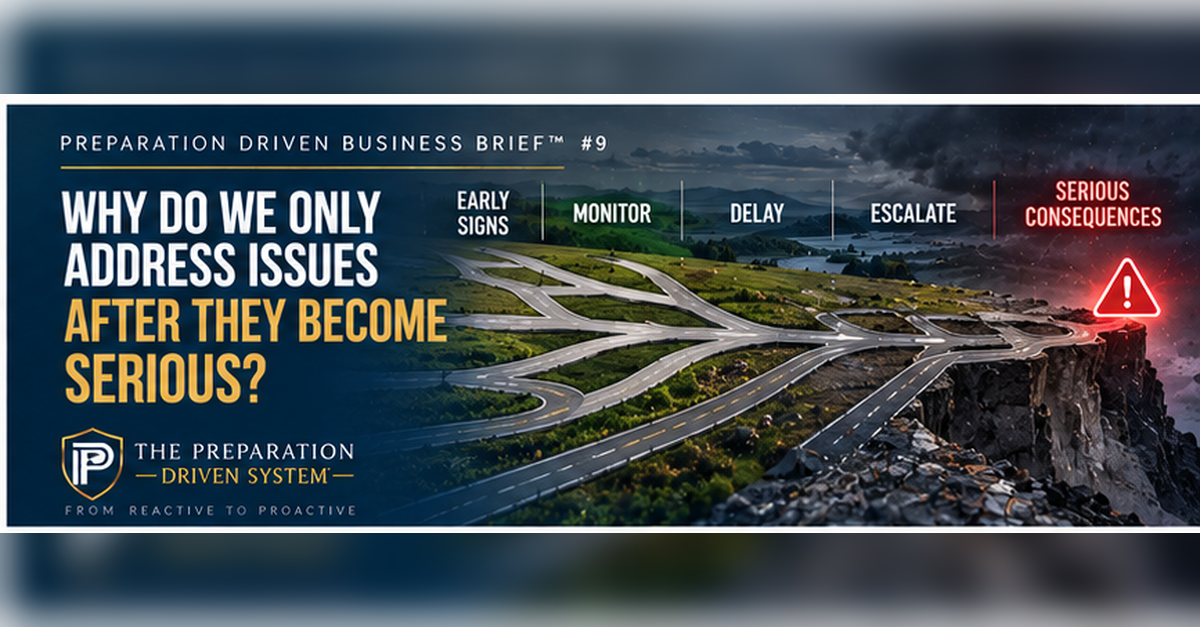
PREPARATION DRIVEN BUSINESS BRIEF™ #9 – Why Do We Only Address Issues After They Become Serious?
October 9, 2026
Why Are Our Leaders Constantly Overwhelmed?
Observation
The leader arrives with a plan for the day.
Before the first hour is over, someone needs an approval. Another manager wants help with an employee issue. A customer problem has escalated. A decision is waiting. A project needs direction. Someone asks, “Do you have five minutes?”
By late afternoon, the leader has successfully helped everyone else move forward.
Their own priorities remain untouched.
This is often explained as the unavoidable burden of leadership.
Sometimes it is something else.
The organization has gradually built its operating model around the leader’s judgment, availability and ability to solve problems.
The leader isn’t simply managing the system.
The leader has become part of the system.
Business Impact
Dependence on capable leaders can initially look like strong leadership.
Problems get solved. Decisions get made. Customers receive attention. Employees know where to go when they’re unsure.
But the better the leader becomes at rescuing situations, the easier it becomes for the organization to rely upon rescue.
Decisions accumulate at the top. Managers hesitate. Employees escalate instead of exercising judgment. Strategic work is postponed because operational issues always have an immediate constituency demanding attention.
Eventually, the organization faces two problems.
The leader is overwhelmed.
And the people around the leader are not developing the confidence, judgment and accountability necessary to reduce that burden.
Being indispensable may feel valuable.
Organizationally, it can become dangerous.
How The Preparation Driven System™ Addresses It
The Preparation Driven System™, created by Todd Smith, reframes leadership capacity as an organizational preparation issue rather than simply a personal time-management problem.
If the same decisions, approvals and problems continually reach a leader, working longer or organizing the calendar more efficiently addresses the symptom.
Preparation-driven leadership looks beneath the workload.
Which decisions could be made elsewhere? What judgment do managers need to develop? Which expectations remain unclear? Where is authority missing? What information does the leader possess that others need? Which recurring problems should have been converted into processes?
The objective is not to make leaders less important.
It is to make their importance different.
Instead of being valuable because everything eventually reaches them, leaders become valuable because they have prepared people and systems to perform effectively without requiring their constant intervention.
Leadership capacity grows when organizational capability grows.
Preparation Principle #10
A leader who must constantly rescue the organization eventually teaches the organization to wait for rescue.
The Question
If you were unavailable for the next thirty days, which decisions, relationships and activities would immediately stall—and what does that reveal about what your organization has not yet been prepared to handle without you?Todd Smith
Creator, The Preparation Driven System™