
PREPARATION DRIVEN BUSINESS BRIEF™ #5 – Why Are We Constantly Behind Schedule?

PREPARATION DRIVEN BUSINESS BRIEF™ #4 -Why Are We Always Reacting Instead of Planning?
October 5, 2026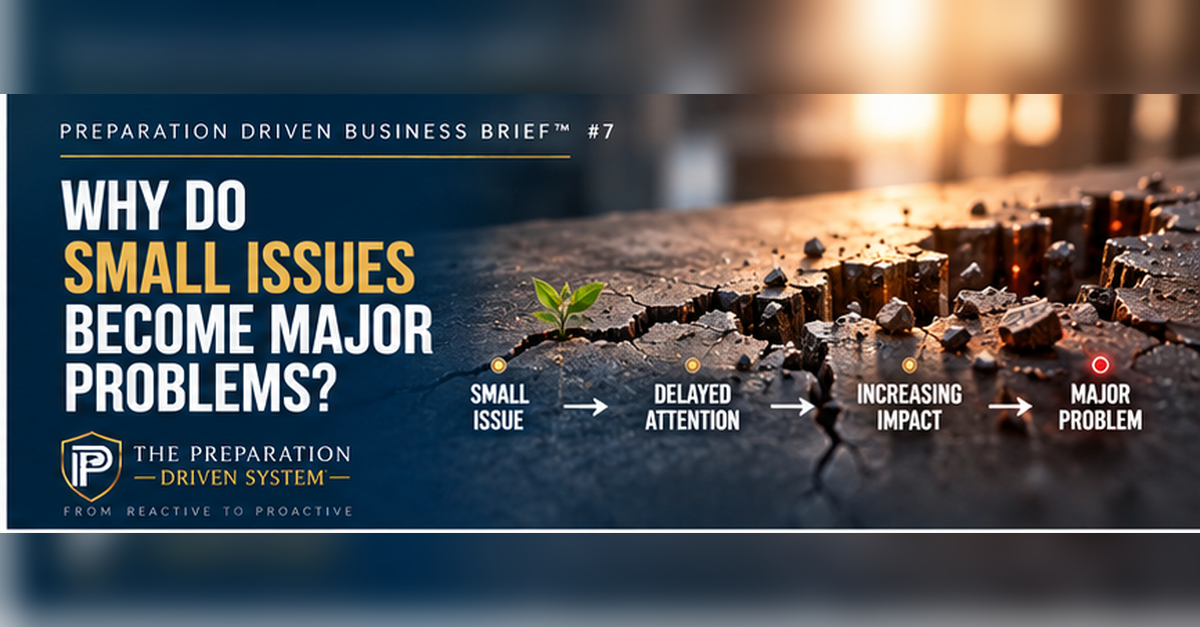
PREPARATION DRIVEN BUSINESS BRIEF™ #7 -Why Do Small Issues Become Major Problems?
October 7, 2026
Why Are We Constantly Behind Schedule?
Observation
When a project falls behind schedule, attention usually turns immediately toward execution.
Who missed the deadline? Why is the team moving too slowly? What needs to happen to catch up?
Those questions may be necessary, but they often begin too late.
Many schedule problems are created before execution starts. Information is incomplete. Responsibilities are unclear. Decisions remain unresolved. Materials or resources aren’t available when needed. Dependencies aren’t identified. Timelines are established around the desired completion date rather than the work actually required to achieve it.
The schedule may ultimately be missed during execution.
But the conditions that made it difficult to achieve were frequently established much earlier.
Business Impact
Poor preparation turns schedules into recovery exercises.
Teams accelerate work to compensate for decisions that should have been made earlier. Managers rearrange resources. Customers receive revised expectations. Employees work around missing information. One delayed activity affects the next, and eventually leadership is managing the consequences of a schedule that was vulnerable before work began.
Speed becomes the attempted solution.
But increasing execution speed cannot always recover time lost through inadequate preparation.
The financial implications can follow quickly: overtime, inefficient resource utilization, disrupted cash flow, delayed billing, lower margins and opportunities that cannot be pursued because resources remain tied to unfinished work.
Being behind schedule is rarely just a scheduling problem.
How The Preparation Driven System™ Addresses It
The Preparation Driven System™, created by Todd Smith, moves part of the scheduling conversation upstream—from “How quickly can we execute?” to “What must be true before execution begins?”
Preparation-driven organizations examine readiness before measuring speed.
Are the necessary decisions complete? Does everyone understand responsibilities and expectations? Is the required information available? Have dependencies been identified? Are resources realistically available when the schedule assumes they will be? What predictable obstacles should already have contingency plans?
This approach doesn’t attempt to eliminate every delay. Markets change. Customers change requirements. Employees become unavailable. Suppliers miss commitments.
But there is an important difference between delays created by genuinely changing circumstances and delays created because known requirements were never adequately prepared for.
Execution matters.
Speed matters.
Deadlines matter.
But the fastest execution team in the world cannot consistently compensate for work that was not ready to begin.
Preparation Principle #5
A missed deadline may occur at the end of the schedule, but the reason for missing it often exists at the beginning.
The Question
Think about a recent project that finished late. If you traced the delay backward instead of examining only where the schedule was finally missed, how far before execution would you find the first indication that the project was not truly ready to begin?