
PREPARATION DRIVEN BUSINESS BRIEF™ #9 – Why Do We Only Address Issues After They Become Serious?

PREPARATION DRIVEN BUSINESS BRIEF™ #6 -Why Do Emergencies Dominate Our Day?
October 9, 2026
PREPARATION DRIVEN BUSINESS BRIEF™ #10 – Why Are Our Leaders Constantly Overwhelmed?
October 10, 2026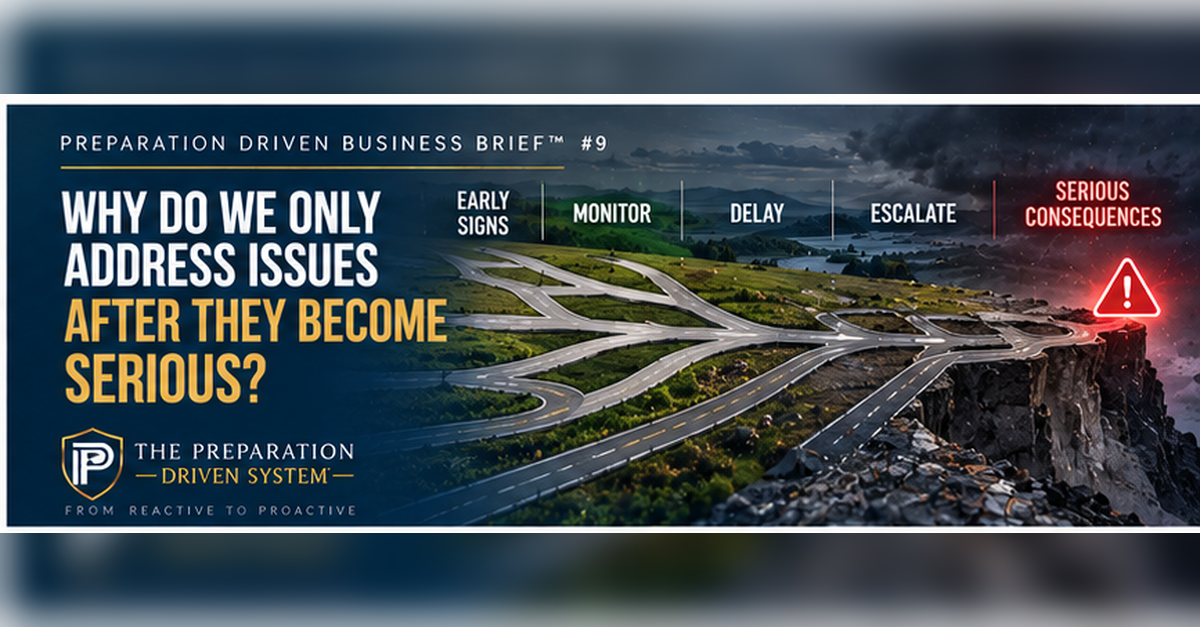
Why Do We Only Address Issues After They Become Serious?
Observation
Organizations frequently recognize developing problems earlier than they admit.
- Someone notices the numbers changing.
- A manager senses an employee problem.
- A salesperson sees customer behavior shifting.
- A project manager knows the schedule is becoming vulnerable.
- A lender relationship deserves attention.
The information exists, but the situation hasn’t crossed the invisible threshold that makes action feel justified.
So leaders wait.
- “We’re monitoring it.”
- “Let’s give it another month.”
- “It may correct itself.”
- “We don’t want to overreact.”
The issue eventually becomes serious enough that nobody questions whether action is necessary.
Unfortunately, by then the organization has exchanged the freedom to act early for the pressure to act immediately.
Business Impact
Waiting for certainty feels responsible because it reduces the risk of acting unnecessarily.
It also carries a cost.
The longer a developing issue continues, the fewer choices leadership may retain. A financial concern that once allowed several solutions can become a liquidity crisis. An employee issue can become a resignation. A customer concern can become lost revenue. A project variance can become a missed deadline.
Once the situation becomes serious, the debate about whether to act disappears.
But so may many of the better options.
Leaders then make decisions under pressure and wonder why the available choices are unattractive.
Often, the better choices existed earlier—when action still felt optional.
How The Preparation Driven System™ Addresses It
The Preparation Driven System™, created by Todd Smith, challenges the assumption that leaders need certainty before preparation is justified.
Preparation and reaction are not the same thing.
Recognizing a developing concern doesn’t require an immediate major intervention. It may require gathering information, creating alternatives, having a conversation, preserving financial capacity, establishing a contingency, or determining what conditions would trigger further action.
Preparation-driven leaders therefore ask two questions:
What do we know now?
And:
What could we reasonably do now that preserves our choices if the situation becomes more serious?
This allows organizations to prepare without overreacting.
The objective isn’t to make decisions prematurely.
It is to prevent delay from quietly making future decisions more difficult.
When leaders prepare while choices still exist, they retain something enormously valuable:
options.
Preparation Principle #9
Waiting for certainty often means waiting until circumstances have eliminated your better options.
The Question
What issue is your organization currently “monitoring”—and if it becomes serious six months from now, which options available today might no longer exist?
Todd Smith
Creator, The Preparation Driven System™